Acocks Green History Society
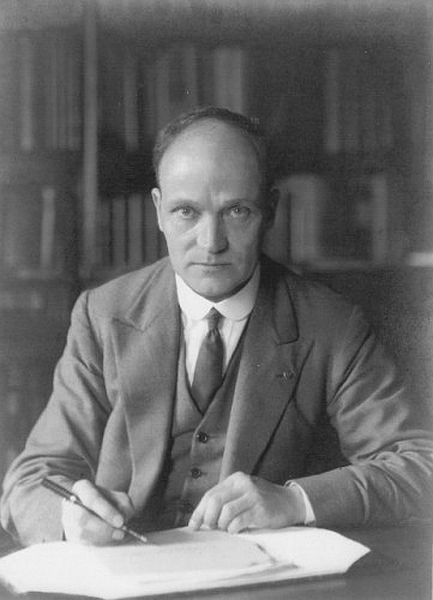
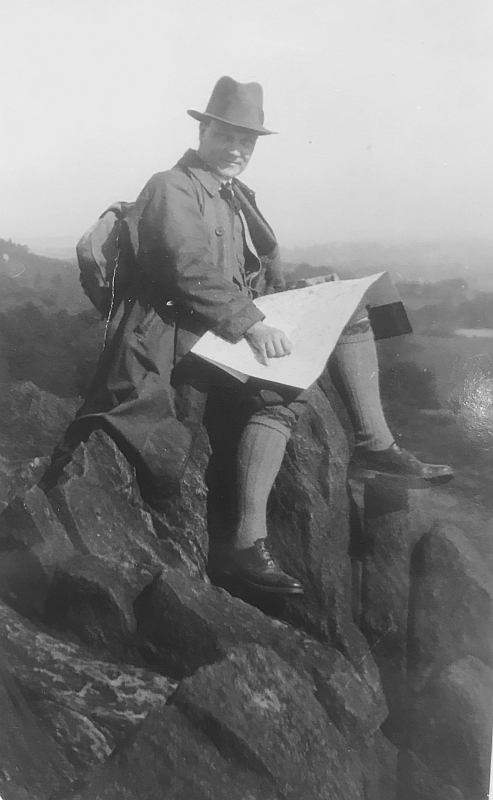
Herbert Maurice Cashmore, Birmingham's Chief Librarian and resident of Acocks Green
H.M. Cashmore: Chief Librarian of Birmingham 1928-1947
We are grateful to Alison Wildsmith for her invaluable assistance with this page. H. M. Cashmore was her maternal great-great uncle. She has a page on Ancestry dedicated to him, which includes additional details and achievements which we have not included here.
Family life
Herbert Maurice Cashmore was born in Islington, London, on 27th January 1882. His father had a building company there, but it failed. Both mother and father were from the Midlands, and they, now plunged into poverty, moved into poor quality housing in Nechells, Birmingham when Herbert was just a baby or toddler.
If that was not bad enough, more and more mouths to feed arrived during the next ten years. In the 1891 census Herbert now had five more brothers. By 1901 there were in addition two more brothers and two sisters. Life must have been very difficult at home, especially before the older boys began to earn a wage. By 1901 Herbert and three other brothers were working. One was a clerk in a whisky business, another was also a clerk, and Herbert was at work in the library service as a library assistant.
In time the young male Cashmores tended to gravitate towards the building trade. There was a family company called B.A. Cashmore (1940 directory). There is evidence that Herbert’s father did not accept or support Herbert’s bookish tendencies. Herbert taught himself using books from a local library, Bloomsbury, as well as through absorbing his school lessons. Herbert had gone to King Edward’s Grammar School, Aston in 1893, having not only passed the entrance exams, but having obtained a full scholarship. Herbert rose to the top class, and was taught amongst boys older than himself (information from Alison Wheatley, archivist at the King Edward's Foundation). He left in 1896, and started work as a junior assistant at Gosta Green branch library.
By the 1911 census, nine of the children were living at home, including Herbert. By now the family was living at Little Green Lane, Wylde Green, Sutton Coldfield. One son, Archibald, was married and had moved away from home. So had Ernest Albert, who had married in 1908. The First World War brought tragedy to the family. Howard Victor was killed on July 1st 1916. Other brothers in the Army and Air Force did survive. Herbert Maurice himself spent part of the War working at a School of Instruction for Infantry Officers. After hostilities ended, the Commandant of the School, Lieut.-Col. H.A.R May, sent a letter to his boss, the Chief Librarian Walter Powell, writing this:
“It has been my good fortune, during 37 years’ military experience, to have been assisted at different times by Officers and N.C.O.s of ability, but I have never had a more capable coadjutor (here meaning someone of equivalent powers/ability if not formal rank [Ed.]) than Sergeant-Major Cashmore. I congratulate the Birmingham Corporation on having in their employment such a highly efficient and hard-working individual”.
The 1921 census shows that the family had split. Herbert Henry, Herbert Maurice’s father, was living at New Oscott with three boarders. He lived until 1939. Meanwhile Herbert Maurice was living at Hartlebury near Droitwich as Head of Household. His mother was there, together with two brothers and two sisters, and the two children of his brother Ernest Albert, whose wife Fanny had died in 1920. Ernest Albert remarried in 1922 and his son Frank was with his father and stepmother in the 1939 register. His daughter Nellie married in 1937.
In 1924 Herbert Maurice moved to number 6 Sherbourne Road in Acocks Green. In 1925 a voters’ list shows his brothers Barry Augustus and Frederick Charles there with him. His mother and sisters were in all likelihood there as well, as they could not vote until 1928, and appeared in the 1929-30 voters' list for that address. The chance to buy a really attractive, architect-designed house, a couple of minutes’ walk away came up in 1929. Herbert Maurice purchased number 17 Greswolde Park Road, and this was to be his home for the rest of his life. In 1930 his mother, two brothers and two unmarried sisters were with him there. By 1935 the two brothers were living elsewhere, one having married, and he was now in an all-female household. His mother Ellen Eliza died in 1949, and his sister Olive Maud in 1955. Herbert Maurice died in 1972 at the age of 90, and was outlived by his sister Dorothy May, who died in 1977.
Cashmore’s philosophy of libraries and his Birmingham career
What makes someone really successful? Talent, personal qualities, drive, choosing the right job, early hardship, maybe. All of these must have contributed to Herbert Maurice’s rise to the top of public and indeed international librarianship. The value of having access to a wide range of books, which he had experienced personally, became a central part of his philosophy of what a public library service should be for.
Herbert Maurice started work in 1896 as a junior assistant in the branch library at Gosta Green. From 1907 after a period as a senior assistant he was in the Central Library in 1912 when a very significant change occurred in his life: he became Deputy Chief Librarian. He was 30 years old. In 1918 his name, and that of his boss Walter Powell, appeared as authors of “A Catalogue of the Birmingham Collection Including Printed Books and Pamphlets, Manuscripts, Maps, Views, Portraits, etc.”: a tome of over 1000 pages. He supervised the creation of a 1918-1931 supplement himself. Walter Powell died in 1928, and Herbert Maurice Cashmore became Chief Librarian.
What is extremely unusual about Cashmore was his ability to impress newspaper reporters. This is from 1930:
“He is thoroughly imbued with the fundamentally sound principles on which the centre and branch libraries have been built up and is extremely popular with the members of his staff, whose work, like his own, necessitates painstaking accuracy and readiness, at all times to assist and advise citizens who borrow books or seek information on an infinite variety of subjects at one or other of the libraries scattered over the city. Criticism of his administration or methods are practically unknown, and the citizens are as proud of Mr. Cashmore as they are of the wonderful collection of books under his competent care”.
Even more impressive is this from 1932:
“Mr. H.M. Cashmore, Birmingham’s Chief Librarian, is one of those people to whom you could stop and listen and talk to all day long without feeling disinterested. He has that enviable capacity for making what are apparently dry subjects and matters intensely interesting. When you have held conversation with him for five minutes it is suddenly realised that he is bringing romance into an imposing table of figures, that he is introducing a problem of sociology to you that you did not even suspect existed, that he has in fact caught you up in a wave of his indomitable energy and enthusiasm and is carrying you into a strange land”.
One year earlier he had appeared in the Evening Despatch newspaper of the 6th August 1931 with an article predicting what the libraries of 1981 would look like. The appearance of something like this is astonishing, given how newspapers have more recently become inclined to make comments about stamping books out and featuring librarians doing silly things to prove they are approachable, in other words making use of rather pathetic stereotypes. Chief Librarians used to be important people in the Council and demanded to be listened to and respected. Now the service has been systematically degraded to be a very vulnerable part of another service. It is in practice seen as an un-wished for burden, whatever some of the public statements purport to say, despite being a Statutory Service.
It is worth looking at Cashmore’s predictions for fifty years ahead from 1931 before going into more detail about the service priorities he had, and the wider achievements of his professional life.
1.More money will be spent on books.
This was true until the mid-1970s.
2.There will be enormously bigger libraries
The John Madin Central Library could be an example of this, but is was out of date in interior layout not long after it opened, and was a poor building in terms of natural light except where the rare books were located, and this was a danger to these books! Cashmore had several large suburban libraries built, like Acocks Green, South Yardley, Ward End and Yardley Wood, which have been able to host events and groups as well as large book collections.
3.Books could be seen via a camera and beamed to TVs in the home on a private wavelength.
This is an intriguing concept, which has come to pass, maybe not in the same way, through digitisation and personal accounts on the internet or freely accessible websites. The idea of being able to use a library’s resources ‘electronically’ without travelling there was surely far-sighted in 1931.
4.Microfilmed books will be read on library equipment, enabling a ‘library in a box’ without the need for expensive buildings. Microfilm can also be used to preserve things produced on poor paper. There will be wireless news and news content on recordings.
Microfilm works for requests for particular items, and for preservation, but has been superseded by digitisation and Optical Character Recognition to enable full-text searching. Browsing to make a choice is perhaps less successful through media than in person with physical books on shelves. However the idea of a limited selection available ‘electronically’ is there with e-books. The implication of being able to do without buildings has been superseded by the internet.
5a.The Shakespeare library should be in the Central Library
This happened and can be preserved better in well-designed storage, especially where non-book material is concerned.
5b.A quote
“During the next fifty years it will be generally recognised that public libraries are the main agency of extra-mural and adult education and worthy of an expenditure greater than a quarter of that spent on formal school teaching”.
This clearly did not happen. While libraries have until the Millennium been able to offer some backup support in this area, there is a need for tutors and course materials which Cashmore, who had educated himself with library books, did not acknowledge here. Adult and Further Education provision became prominent features in our lives, both for vocational and ‘leisure’ purposes. Public libraries like Birmingham used to have a reasonable amount of material useful to university students. Now they struggle to finance secondary school level materials to GCSE.
5c.There will be wireless requests for information by practically everybody.
Far more people access information now, but not through libraries. The internet and mobile phones enable easy access to information, even if much of it is poor or biased. Cashmore’s vision implies large numbers of staff providing quality information on a very large scale. Was that ever practicable?
5d. Another quote.
“Long before 1981 all libraries (however small) belonging to the public will be administered by one staff in constant touch with all departments of public activity, always at the service of every citizen everywhere. Even at present local government and national boundaries mean little to the best librarians: in fifty years’ time they will mean nothing”.
Behind this is a passionate vision that the values of librarianship transcend politics and have a universal reach. It is a regrettable fact that public libraries have been exposed to more and more political pressure to spend staff and materials resources on political priorities, while at the same time being told that they are going to have less and less money. Local authorities ceased to be an appropriate home for public libraries long ago, unless you subscribe to the view that everything paid for out of the public purse has to be tightly politically controlled for reasons of democracy.
6a.Libraries will be controlled internationally. There will be a “Bureau of intellectual Co-operation” with local administration and variation. Inter-Library loans are expanding so libraries are already international.
Most people would see this as unworkable. There is a difference between the value of having access to materials from other countries and having a bureaucratic structure covering many countries running the service. The example of EU regulation overreach might be quoted here. To be fair, the local variation covers responsiveness to local communities by implication, but the idea of a pan-European run service, say, might seem to be taking the idea of the universality of libraries too far.
6b. Another quote
“Libraries of the future will be on more ambitious lines: they will have special departments for maps, prints and photographic work, collections of gramophone records and manuscript documents, receiving and transmitting apparatus for wireless telegraphy and television, soundproof music rooms and great collections of music, and staffs equal to dealing with any question that can be answered from printed or manuscript material or on application to experts”.
One can certainly say that this vision has been achieved, even though the technologies used are different and continue to change, leading to much more expense on equipment. In fact, where Birmingham Central Library was concerned, you could see this service a decade earlier than Cashmore envisaged. Highly specialised staff working in business information, local history, patents, music and special collections, for example, provided an excellent service, and all departments were staffed by some very knowledgeable librarians.
Overall, Cashmore was an excellent promoter of libraries, so much so that in 1934 a reporter was driven to declare that librarians are the “Miracle Men of Birmingham”.
Turning now to the many things he said in print elsewhere in the newspapers, he said in 1931 that low readership numbers was down to not enough being spent on public libraries. He made the point that multiple copies of important books were needed so that people did not have to wait a long time for them. He felt that the unemployed were making increased use of libraries, and 1933 disapproved of a public appeal for books for the unemployed, as the library service had plenty of quality stock for them. So he naturally wanted to draw attention to the service and seek more funding for quality books.
He had something interesting to say in 1935 about censorship, about books that public libraries should not have. For him the reader has a personal responsibility to read or not to read. The Bible could be seen as very objectionable because of its frankness. He admitted that some books were under lock and key and could be accessed only on application, but said far more damage was done by sickly, sentimental romances:
“Far more young girls have had real damage done to them by pernicious and mawkish romantic twaddle than by honest to goodness literature about the very stuff of life”.
He was amazed by the learning and scope of interests of readers. Be that as it may, public libraries do regard romances as a genre many people enjoy and which fulfil a need on some psychological level, a bit like Westerns did for men, and adventures, detectives historical and science fiction still do for very large numbers of readers.
Cashmore was interested in improving the special collections the service held. In 1929 he appealed for donations of lantern slides. The library service had 16,000 but needed more on science, Birmingham and the Colonies.
In 1935 he appealed for local businesses to deposit their out-of-date records in the library, but he was later to say he was disappointed at the response. Some businesses were not happy at the idea of the public nosing around in records of what they had being doing! In 1946 he appealed for local societies and institutions to donate their records to the Birmingham Collection.
Cashmore declared that Birmingham had the best Shakespeare collection in the world. In 1931 he appealed for newscuttings, particularly about Shakespeare. In 1934 he inaugurated a worldwide search for materials about Shakespeare, in conjunction with Sir Robert Vansittart of the Foreign Office. All embassies and consulates were urged to go out and acquire local stock, and they were all sent a list of Birmingham’s current holdings. In just over six months over three hundred volumes were sent to Birmingham. Acquiring foreign language and English language material published abroad continued after this, and is a strong feature of Birmingham’s Shakespeare collection.
First World War Poetry was another special collection Cashmore promoted, as well as the Rare Books Collection, part of which was exhibited in the Council House for a week in 1946. The Commercial Library was started in 1919.
In 1947, right at the end of his career, books and newspapers were sent to Cologne to enable Germans in the British Zone to understand British culture. The intention was to compete with U.S. and Russian influences on the country. Cashmore pointed out that these were discarded items to forestall criticism.
One area where he was perhaps limited by his time was in the area of supporting children’s homework. In 1938, there was an article about homework rooms being provided in some places in the country, but Cashmore did not think this could be afforded, and would require separate buildings. Referring to individual cubicles as well as rooms, he said that public libraries could only support a tiny number of children in this way. He felt that the swarms of children who descended on the libraries after school would not allow the quiet space needed for homework, which could be found at home. This is a most curious stance, as the 1930s libraries he built had separate rooms for magazines and for newspapers, which only catered for a small number of people at a time. He himself must have found it incredibly difficult to do his homework at home, given the number of siblings he had and the size of property the family lived in. He must have known that countless Birmingham children would struggle to use their home environment to do work for school, as they would be expected to help out with household chores, never mind the noise level around them. Work with children, including promoting reading for pleasure and more recently curriculum-related stock and Homework Help Clubs, has been progressively more important in Birmingham’s libraries, and it could be argued is the most important thing they do.
Returning to subjects mentioned several times above, the adequacy of stock available and the limits imposed by library authority boundaries, Cashmore was deeply involved in developments starting in the 1930s.
Firstly, he declared in 1934 that the costs of all free libraries should be spread over the whole country, and that it was obviously unfair that because people are massed together they should have better libraries than people who are scattered. He also said that the whole of the Midlands should be linked up for library purposes. Here is a declaration that library funding should not be based on the amount that could be raised from local rates due to the size of the population. However, what he did not mention was that where there were many people close to each other, up to 50% of the stock would not be on the shelves at any time. In towns and cities there were not the travel barriers which existed in rural communities, and so the effective stock availability was up to only half of what the catalogue said.
Here is where a rather bureaucratic-sounding coalition of the willing played a part: the West Midlands Regional Library Bureau. It was not capable of equalising access as envisaged above, but could supply stock requested for particular needs. Birmingham as the largest library authority in the area would obviously give more than it received. Regional Library Bureaux were intended to complement the stock held by the National Central Library for Students, which moved in 1933 to a new location in London at Bloomsbury. We of course know this as the British Library.
After six months Birmingham had lent 1,105 volumes, and Coventry had lent 7. Cashmore expressed himself dissatisfied with the type of book exchanged so far. He would be more satisfied if more important and expensive books were requested. “I hope it will never be regarded as the duty of the bureau to circulate cheap and popular literature”, he declared. He was going against the grain of later thought here, as after the War Provincial Joint Fiction Reserves were set up to try to ensure that there was a copy of every fiction title held somewhere. By 1939 fifty-three libraries belonged to the West Midlands RLB. In that year there were 8,355 requests. Birmingham borrowed 295 volumes, but lent out 6,773. In 1948, Birmingham supplied 16,727 books to other libraries. By 1949 fifty-seven libraries were taking part. Birmingham successfully fulfilled seventeen out of twenty-two requests received, whereas the National Central library failed to do this on nearly half of the occasions it was asked. In the same year, an Oldbury man’s request for a German language item was fulfilled by a book from New York libraries, truly an international achievement.
When he became Chief Librarian Cashmore started to plan for a new type of suburban library. After four years of preparatory work and then building, he was able to open Acocks Green library in June 1932. According to him, it would be the best of all the libraries. It would be bright and open, and allow users open access to the books. Previously, staff would have fetched the books from closed shelves to a hatch, where the reader could then proceed to borrow it. Open access seems natural now, although closed access is common in some contexts in universities and where library stacks are concerned. Open access derives as an idea from the Indian library philosopher Dr. S.R. Ranganathan. Of his 1931 Five Laws of Library Science, the first one – Books are for Use – is relevant here. It takes the emphasis away from storage and security to access, to enable more use to be made of books. It also enables browsing of actual books, not just the catalogue, and also enables serendipity as well as the choice of alternatives to what was initially sought. Brighter libraries, more like shops in the visitor experience, were an idea of the time, also deriving from Ranganathan's ideas.
International and other activity
In 1935 Cashmore became the Hon. Treasurer of the Library Association.
In 1936 Cashmore travelled over 12,000 miles in Europe and Russia to undertake a survey of libraries on behalf of the Library Association and the Rockefeller Foundation. It took him three months. He was particularly impressed with the great strides Russia had made:
“It is the greatest miracle of history: 150,000,000 people, lazy, illiterate, drunken, have been turned into a healthy, literate nation”. He said that libraries in the population centres were larger than those in the U.K. “They have probably a greater selection of books, especially for schoolchildren – there is a school technical library in the suburbs of Leningrad of 1,500,000…”
In the summer of 1941 Cashmore was sent by the Foreign Office and the Library Association to the American Library Association conference in Boston. He was the sole European never mind British librarian there. He was to talk on protecting libraries from air raids, and to meet representatives from thirteen states to discuss post-war reconstruction. (At home he was a member of the National Committee on Defence Activities and Libraries). The journey there was an adventure in itself. He flew from Bristol to Lisbon then on a PAA Yankee Clipper flying boat to the Azores, then Bermuda, and lastly to New York. He then undertook an extended tour of the U.S.A. and Canada at the request of the A.L.A. While in Boston he said he had countless informal conversations, which he said were often more useful than giving a lecture.
In 1946 Cashmore was inaugurated President of the Library Association for that year. Far from gliding his way serenely through so near to retirement, he was very active, travelling to France as well as Switzerland (See below), and attended many important meetings and conferences, gave talks, and served on inquiries.
In 1946, he travelled to Geneva for a conference of the International Federation of Library Associations. There he was nominated to be an Hon. Vice President. He had been working with I.F.L.A. since before the Second World War. In May 1947, shortly after he retired, he went as the only British delegate to the I.F.L.A. conference in Oslo. This was a transformative event for I.F.L.A. as a formal agreement was made with the newly-formed U.N.E.S.C.O., leading to I.F.L.A. acquiring more international status and support as a global voice for the library and information professions. At the Conference, Cashmore was confirmed as one of three (Honorary) Vice-Presidents. (He was re-elected in 1964). He then went on to lead a deputation of British librarians to Denmark. On his return, he was taken ill on a train, and was hospitalised in London, leading him to miss the presentation of a silver inkstand from the Regional Library Bureau for his work for them since 1931.
After retirement, Cashmore became Emeritus City librarian. In 1948 he was awarded the M.B.E. In the same year, he and two Birmingham library staff were given the task of compiling Birmingham's Book of Remembrance. This was a complex undertaking, leading ultimately to the placement of an illuminated copy of the list in the Hall of Memory in 1950.
In 1952 he was made an Honorary Fellow of I.F.L.A., the highest accolade it was possible for them to bestow. This is not an annual award, but is given only on merit to someone who has given distinguished service to I.F.L.A. and the global library field.